
How to Get a Custom Medal Quote Without Knowing Every Manufacturing Detail
If you are ordering custom medals for the first time, requesting a quotation can feel more complicated than expected.
What material should you choose? How thick should the medal be? Do you need 2D or 3D relief? What type of plating or color finish is suitable?
These are all useful questions, but you do not need to know every manufacturing detail before contacting a supplier.
A custom medal manufacturer should be able to help you identify the missing details and explain which decisions are important.
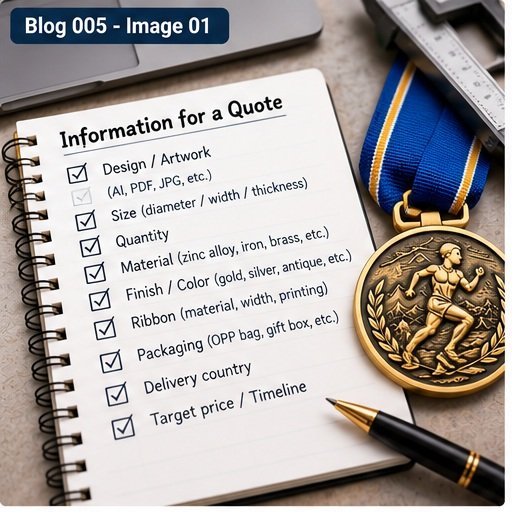
In many cases, three pieces of information are enough to begin a preliminary cost assessment: size, artwork and quantity.
1. Start With Three Essential Details
Medal size
If you have a preferred diameter or dimensions, share them with the manufacturer.
For example, you may be considering a 70 mm round medal or a custom-shaped medal approximately 60 mm wide.
The exact dimensions may change after reviewing the artwork, but an estimated size helps establish the manufacturing requirements.
Artwork or a reference image
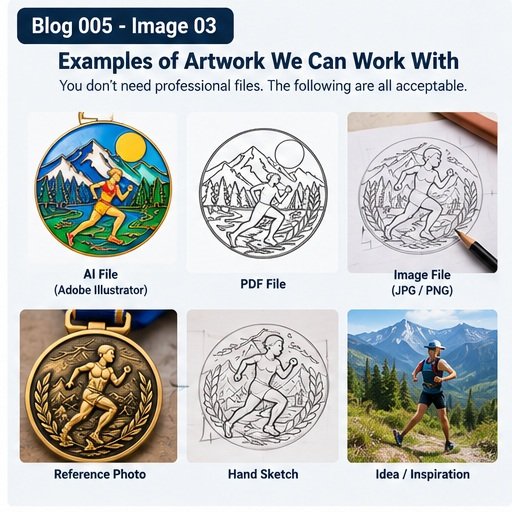
A finished production drawing is not always necessary for an initial inquiry.
You can provide an existing design, a sketch, a reference photograph or an AI-generated concept image.
However, a reference image should not automatically be treated as a production-ready design.
The manufacturer may need to review details such as relief depth, color boundaries, open areas and metal thickness before confirming what can actually be made.
Estimated quantity
Let the manufacturer know how many medals you expect to order.
Even if the final number is not confirmed, an estimate is useful for evaluating production costs.
With these three details, a manufacturer can often begin discussing an approximate price or price range.
2. What If You Don’t Know the Thickness or Material?
Not every buyer knows what a standard medal thickness should be.
You might simply say, “I want a normal thickness.”
That is understandable, but there is no single thickness that is suitable for every medal.
The right specification depends on the design, intended weight, manufacturing process and budget.
Rather than expecting buyers to choose every technical detail themselves, the manufacturer can review the artwork and suggest a reasonable starting specification.
The same applies to material selection.
Zinc alloy die casting is suitable for many detailed custom medals, while certain simpler designs may be appropriate for stamped metal production.
These decisions should be based on the actual product requirements.
If the manufacturer uses assumptions to prepare an initial estimate, those assumptions should be stated clearly.
3. Preliminary Estimate vs Final Quotation
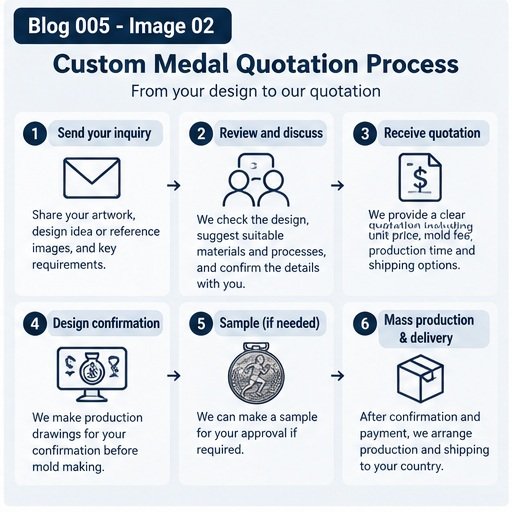
A preliminary estimate and a confirmed production quotation serve different purposes.
A preliminary estimate helps you understand whether a design is likely to fit your budget.
It may be based on an approximate size, assumed thickness, estimated metal weight and a proposed manufacturing process.
The price may change when those details are confirmed.
A final quotation should be based on sufficiently clear product specifications and commercial requirements.
These may include:
- Confirmed dimensions and thickness.
- Material and manufacturing method.
- Relief design and surface finish.
- Enamel colors or printing requirements.
- Ribbon specifications and packaging.
- Order quantity and tooling requirements.
- Delivery destination and shipping terms, where applicable.
You do not necessarily need to supply all these details in your first message.
They become important as the project moves toward order confirmation.
A useful quotation should make it clear what has been included and what still needs confirmation.
4. Why Do Buyers Request Prices for 100, 500 and 1,000 Medals?
It is common for buyers to request several quantity options.
For example:
“Please quote 100, 500 and 1,000 medals.”
This is a reasonable way to compare possible purchasing volumes, particularly when an event’s attendance or a reseller’s demand is still uncertain.
However, manufacturing prices do not always decrease evenly as quantities increase.
Different factories have different equipment, cost structures and quantity thresholds.
For some products, the manufacturing cost difference between 100 and 500 pieces may be small enough that the supplier offers the same unit price.
A larger quantity may produce a more meaningful change, depending on the order.
This does not mean the quotation is incorrect.
It means that real manufacturing costs do not necessarily follow a simple, fixed discount percentage.
Buyers should also distinguish between the unit production price and the total order cost.
Ordering more medals may lower the unit price while increasing the overall amount spent.
The most economical quantity is therefore not always the largest quantity.
5. Understand the Mold Cost Separately
Custom metal medals may require a dedicated mold, particularly for designs produced through die casting or stamping.
Mold preparation is generally a separate cost consideration from the production of each medal.
For a small order, this one-time tooling expense can represent a significant portion of the project budget.
As the order quantity increases, the mold cost can be spread across more pieces.
Some manufacturers may reduce or waive tooling charges for qualifying larger orders, but this depends on their quotation policy and the specific design.
Buyers should check whether mold fees are included in the quoted total or listed separately.
It is also worth clarifying whether a repeat order using the same design will require additional tooling charges.
6. Do You Need to Share Your Budget?
Providing a target budget can help a manufacturer evaluate whether the proposed specifications are realistic.
For example, if your target price is below the cost of the original design, the manufacturer may be able to discuss adjustments to weight, thickness, relief details or finishing requirements.
But sharing a budget is not mandatory.
Some buyers prefer to receive an initial quotation before deciding whether to discuss their target price.
That is a normal purchasing approach.
At Medal-Ray, our preference is to begin with the requirements the buyer actually provides.
We prepare the initial quotation based on the requested product rather than automatically presenting several alternative versions.
If the quoted price does not meet the buyer’s expectations, we can then review possible changes together.
This keeps the initial decision clear while leaving room for practical cost optimization when it is needed.
7. Don’t Forget the Delivery Requirements
Before placing an order, confirm the expected delivery destination and any important event deadline.
The manufacturing lead time and shipping time are different parts of the schedule.
A product may take a certain number of days to manufacture after approvals, while delivery can require additional time depending on the destination and shipping method.
For international orders, it is also important to clarify whether the quotation covers the products only or includes transportation, customs arrangements or other delivery charges.
A low unit price may not represent the lowest total delivered cost.
Clear delivery terms help prevent misunderstandings when comparing quotations.
8. A Simple Example of a First Inquiry
You do not need to write a long technical document to start.
A useful first inquiry could be:
“Hello, I would like a quotation for 500 custom medals. The approximate diameter is 70 mm, and I have attached a reference design. Please advise on suitable materials and manufacturing options. The medals are needed for an event in November.”
This message gives the manufacturer enough context to begin evaluating the project.
The manufacturer can then ask only for the additional details needed to prepare a meaningful estimate.
Final Thoughts
Requesting a custom medal quotation should not require you to become a manufacturing expert.
Start with the size, artwork and estimated quantity.
If you already know your preferred material, finish, ribbon or delivery requirements, include them as well.
If you are unsure, explain what the medals are for and what matters most to your project.
A useful manufacturer should help turn those ideas into clear specifications rather than simply asking you to make every technical decision yourself.
A clear starting point makes a useful quotation possible — even before every detail is finalized.
At Medal-Ray, we focus on understanding your requirements and helping you make practical manufacturing decisions.
More Than Just a Quotation.
For custom medal inquiries, contact ray@craftmedals.com.
Have a Custom Medal Project?
Share your design, size and estimated quantity. We’ll help review the manufacturing requirements.