
Soft Enamel, Imitation Hard Enamel or UV Printing: Which Should You Choose?
When ordering custom medals, buyers often spend a great deal of time choosing the design, dimensions and metal color.
But there is another decision that can significantly affect the finished product: how the colors are applied.
Soft enamel, imitation hard enamel and UV printing can all create attractive custom medals. However, they work differently and are not always interchangeable.
The choice affects the appearance, design requirements, manufacturing operations and sometimes the production schedule.
Understanding these differences before approving the artwork can prevent unnecessary design changes later.
1. Soft Enamel: A Traditional Choice for Defined Color Areas
Soft enamel is commonly used for medals with clear logos, lettering, symbols and separate color sections.
In a typical soft enamel design, the metal surface contains raised borders and recessed areas.
Color is applied into the recessed sections and then cured. The raised metal borders remain visible and usually sit slightly above the colored areas.
This creates a recognizable combination of metal outlines and colored sections.
Soft enamel works particularly well when the artwork has clearly separated color areas.
For example, a medal with a sporting event logo, bold lettering and several solid colors may be well suited to soft enamel.
However, conventional enamel filling is not the same as printing an image.
Gradients, photographic details and colors without suitable dividing boundaries can be difficult to reproduce directly.
If the buyer specifically wants soft enamel, parts of the original artwork may need to be simplified or redesigned.
The important question is not just how many colors appear in the design, but whether those colors can be separated into manufacturable areas.
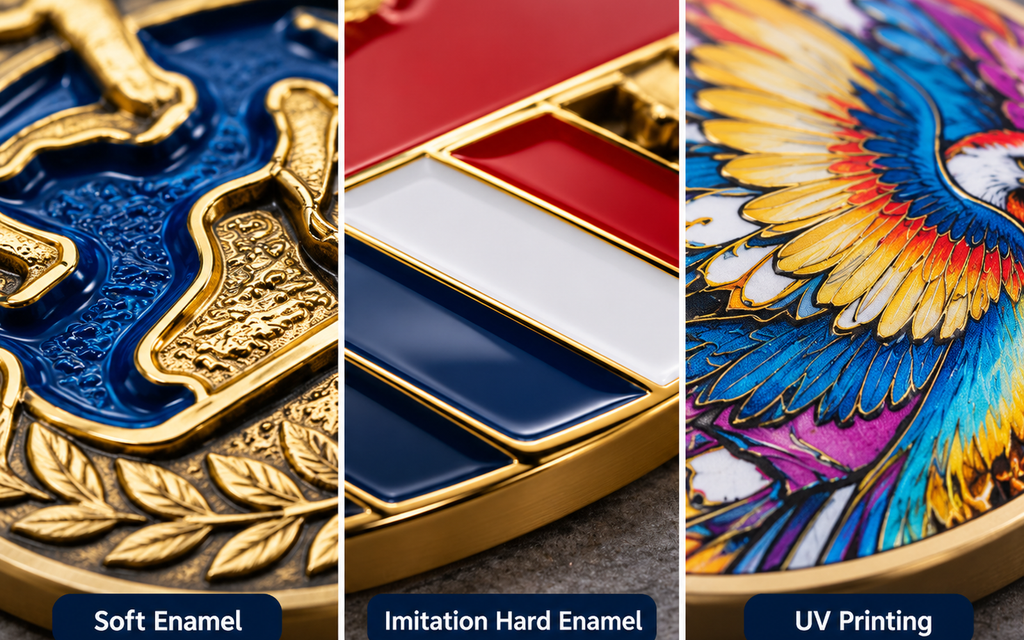
2. Imitation Hard Enamel: A Smoother Surface With Additional Processing
Imitation hard enamel is often selected when buyers want a smoother, more even surface.
Unlike traditional soft enamel, where the color areas typically remain recessed, imitation hard enamel is designed to create a relatively level finish between the colored sections and the surrounding metal.
Achieving this effect generally requires controlled color filling, curing and additional leveling or polishing operations.
Mold accuracy and the structure of the color areas are also important because the finishing process must produce the intended smooth appearance.
These additional manufacturing requirements can make imitation hard enamel more demanding than conventional soft enamel.
The result can be a refined finish, particularly for designs with carefully separated color sections.
However, imitation hard enamel is not suitable for every artwork.
Complex curved 3D relief surfaces generally do not lend themselves to the same leveling process as flat or appropriately structured enamel areas.
A medal can contain different design features, but the areas intended for imitation hard enamel must be planned accordingly.
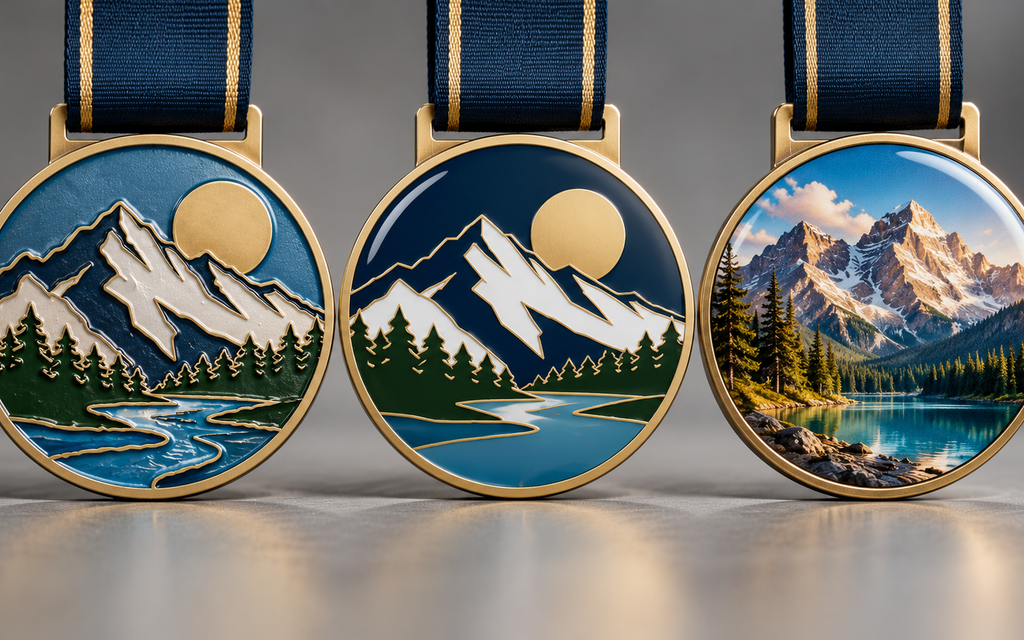
3. Why Can Imitation Hard Enamel Take Longer?
Buyers sometimes assume that choosing a different color finish will have little effect on the manufacturing schedule.
In practice, that is not always true.
At the factories we work with, conventional custom medal production may take approximately 10–15 days after the necessary approvals and production arrangements.
For projects involving imitation hard enamel, the production period may be closer to 20–30 days, depending on the design and order requirements.
This difference reflects additional processing, finishing and inspection requirements.
These figures are practical references from our manufacturing experience, not guaranteed industry-wide lead times.
Actual schedules depend on artwork approval, order quantity, manufacturing capacity and the complexity of the finish. Shipping time is separate.
For medals needed by a fixed event date, confirming the production schedule before choosing imitation hard enamel is particularly important.
A finish that looks attractive may not be the best choice if it cannot reasonably meet the project timeline.
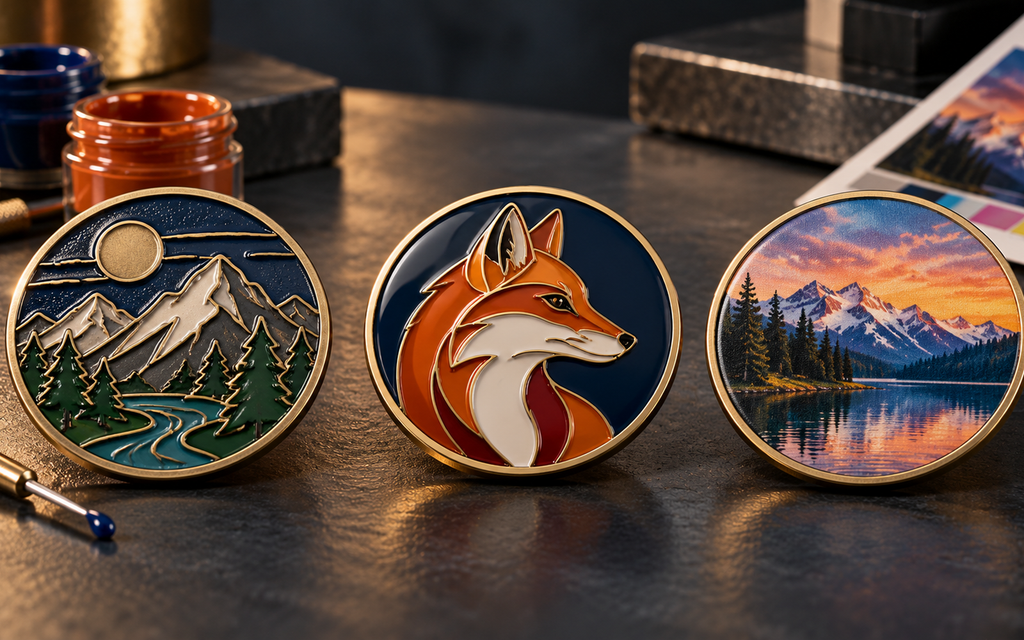
4. UV Printing: More Freedom for Complex Artwork
UV printing applies ink directly onto a prepared surface and cures it using ultraviolet light.
It can reproduce visual elements that conventional enamel filling may struggle to achieve, including gradients, intricate graphics and multicolored artwork without clearly separated metal borders.
This makes UV printing useful for certain detailed designs.
For example, artwork with subtle color transitions, complex illustrations or very small decorative elements may be better suited to printing than traditional enamel filling.
However, UV printing introduces different considerations.
Unlike enamel contained within recessed metal areas, printed ink is generally exposed on or near the product surface.
Its durability depends on factors such as surface preparation, ink adhesion, protective treatment and the conditions in which the medal is used.
Frequent abrasion, scratching or unsuitable environmental exposure can increase the risk of visible wear or damage to the printed layer.
This does not mean UV printing is automatically poor quality or unsuitable for commemorative medals.
It means that the intended use and durability expectations should be reviewed before selecting the process.
5. Can Soft Enamel and UV Printing Be Combined?
Yes. Combining traditional enamel with local UV printing is a practical approach for suitable designs.
A medal might use soft enamel for its main solid-color sections while using UV printing for a small area containing gradients or intricate artwork.
This can help preserve the appearance of traditional enamel without unnecessarily simplifying every part of the design.
However, combining processes requires manufacturing review.
The location of the printed areas, differences in surface height, ink adhesion and production sequence all need to be considered.
Additional operations may also affect the cost and schedule.
A combined finish is therefore not automatically the cheapest solution, but it can be a useful compromise when a design needs both traditional enamel and printed detail.
6. What If the Buyer Requests Enamel but the Artwork Requires Printing?
This is a common manufacturing discussion.
A buyer may specifically request soft enamel because they prefer its traditional metal-and-color appearance.
But the supplied artwork may include photographic effects, gradients or complicated color transitions that cannot be reproduced as conventional enamel sections without modification.
In that situation, the manufacturer should explain which parts of the artwork present difficulties.
If preserving the original visual details is the priority, UV printing may be considered.
If the buyer wants to maintain traditional enamel, the artwork may need to be simplified, with clearer color areas and suitable metal boundaries.
The goal should not be to reject the buyer’s preference or silently change the manufacturing process.
The goal is to explain what each process can realistically achieve so that the buyer can approve an informed design decision.
7. How Should Buyers Choose?
A practical comparison begins with the design itself.
Choose soft enamel when:
The artwork uses clear, separate color sections, and the buyer prefers traditional metal borders with recessed color areas.
Consider imitation hard enamel when:
A smooth, relatively level surface is important, the design supports the process, and the production schedule allows for additional finishing work.
Consider UV printing when:
The design contains gradients, complex illustrations or details that are difficult to reproduce through conventional enamel filling.
Consider combining processes when:
The medal needs traditional enamel in some areas and detailed printed graphics in others, provided the structure is suitable.
Cost is also important, but no single process is automatically the least expensive for every project.
Actual costs depend on the design, printing or filling area, number of operations, required quality and production quantity.
Final Thoughts
Soft enamel, imitation hard enamel and UV printing are not simply three different levels of quality.
They are different manufacturing methods designed to achieve different visual results.
A design with distinct color sections may be well suited to soft enamel.
A smooth, carefully finished surface may justify imitation hard enamel and its additional production requirements.
Complex multicolored artwork may benefit from UV printing, while certain projects can combine printing and enamel.
The best decision comes from reviewing the actual artwork, expected appearance, durability requirements, budget and delivery schedule together.
At Medal-Ray, we believe manufacturing advice should begin with explaining what is practical — including when a design needs to change to achieve the finish a buyer wants.
The right coloring process starts with the right design.
More Than Just a Quotation.
For custom medal inquiries, contact ray@craftmedals.com.
Have a Custom Medal Project?
Share your design, size and estimated quantity. We’ll help review the manufacturing requirements.