
2D vs 3D Custom Medals: Why the Right Finish Matters
When choosing custom medals, many buyers are asked an early question: Do you want a 2D or 3D design?
At first, the answer may seem simple.
3D medals offer more sculptural detail, while 2D medals have a flatter appearance. This can make 3D sound like the obvious choice for a premium product.
But in actual manufacturing, the decision is not always that straightforward.
The right choice depends on the artwork, the type of color finish required, the intended appearance and the buyer’s budget.
A well-designed 2D medal can be a better manufacturing choice than an unnecessarily complicated 3D medal.
1. What Is the Difference Between 2D and 3D Medals?
A 2D medal typically uses distinct raised and recessed areas. The design may include lettering, logos, geometric shapes and clearly separated color sections.
The height differences are relatively simple and defined.
A 3D medal allows more gradual transitions between different relief heights. This makes it suitable for sculptural features such as faces, animals, buildings and other designs that benefit from curves, contours and depth.
For example, a medal featuring a detailed portrait may benefit from 3D modeling because the face requires more natural changes in height.
A medal featuring a bold event logo and several blocks of color may not need this complexity.
Both methods can produce attractive custom medals when used for suitable designs.
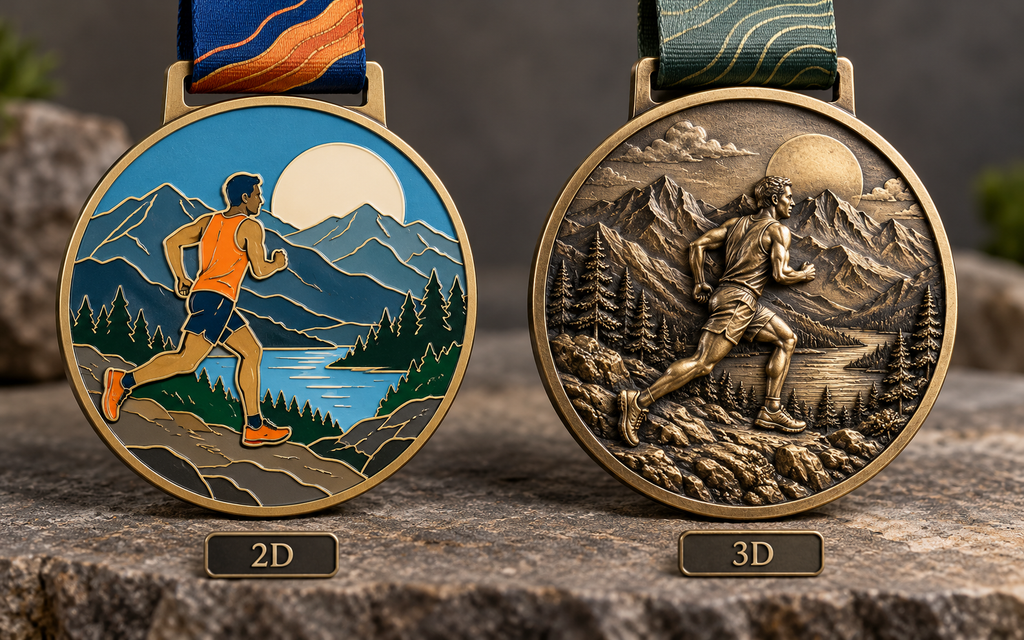
2. Why Have 3D Medals Become More Popular?
Historically, complex relief designs could require more demanding mold preparation and manufacturing work.
Simpler 2D construction was therefore an attractive option for many cost-conscious orders.
As digital modeling, mold-making equipment and manufacturing processes have developed, producing detailed 3D relief has become more accessible.
Buyers can now consider dimensional designs that may previously have been less practical for their projects.
At the same time, expectations for medal appearance have changed.
Many event organizers want medals that feel more distinctive, with visible depth and detailed metalwork.
However, better manufacturing capability does not eliminate cost differences. The complexity of the artwork, mold requirements and finishing operations still matter.
A 3D medal is not automatically expensive, but neither is it automatically available at the price of a simpler 2D design.

3. Why 2D Is Still a Good Choice for Colored Medals
One of the most important differences between 2D and 3D designs is how color can be applied.
Traditional soft enamel involves filling recessed areas with color. These areas generally need suitable boundaries to keep colors separated.
This makes 2D designs particularly useful for medals featuring:
- Event logos with distinct colors.
- Lettering and graphic symbols.
- Geometric patterns.
- Clearly divided enamel color areas.
Some buyers specifically prefer the appearance of traditional enamel rather than a printed image.
For them, the ability to create well-defined metal borders and controlled color sections may be more important than having deeper sculptural relief.
This is why a 2D medal should not be considered an outdated or inferior product.
It can be the right technical solution for the intended appearance.
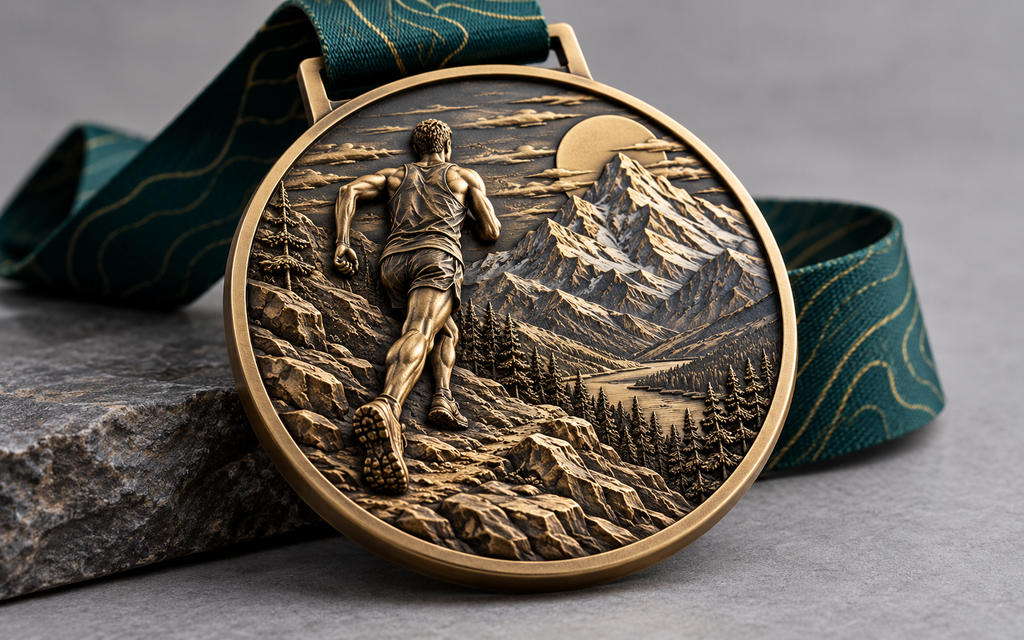
4. When Does 3D Relief Make More Sense?
3D relief becomes especially useful when the design relies on shape rather than only on color.
Examples include detailed figures, architectural features, animals, landscapes and decorative surfaces with changing heights.
These elements can appear more natural when modeled with gradual relief transitions.
A metal-only 3D design can also make strong use of plating and surface texture to emphasize highlights and shadows.
However, highly dimensional surfaces may introduce challenges for certain coloring methods.
If a design requires complex gradients or full-color artwork across irregular surfaces, UV printing may be considered, subject to the actual printing area and production conditions.
UV printing can reproduce effects that would be difficult to achieve using conventional recessed enamel filling.
Its suitability should still be evaluated carefully, particularly where the printed surface may experience frequent handling, abrasion or other wear.
5. Can 3D Medals Use Enamel?
Yes, in suitable designs.
A 3D medal does not have to be entirely metal-colored or UV printed.
Some designs combine raised sculptural areas with recessed sections that can be filled using soft enamel.
The important question is whether the design provides suitable areas for the chosen coloring process.
For imitation hard enamel, the situation is different.
This process generally relies on controlled filling and subsequent leveling or polishing to achieve a smooth surface, with color areas approximately level with the metal borders.
It is therefore better suited to appropriately designed, relatively flat color sections than to complex curved relief surfaces.
In some products, different decorative processes may be combined, but the specific structure must be evaluated before production.
The choice of relief and the choice of color finish should be considered together, not as two unrelated decisions.
6. Is 3D Always Worth the Additional Cost?
Not necessarily.
A premium medal is not defined only by whether the artwork is labeled 2D or 3D.
A clean 2D design with carefully selected enamel colors and metal finishing can look refined and professional.
A 3D medal with unnecessary detail may increase design complexity without improving the appearance that the buyer actually wants.
The cost difference also depends on the manufacturer’s equipment, mold requirements, production quantity and finishing process.
There is no universal rule that every 3D medal costs a fixed percentage more than its 2D equivalent.
The more useful question is:
Does the additional relief make the finished medal better for its intended purpose?
If the answer is yes, 3D may be worth considering.
If the design is mainly about clear logos, typography and enamel color blocks, 2D may be equally appropriate — or even preferable.
7. How Should Buyers Choose?
Before deciding between 2D and 3D, consider three questions.
What should stand out in the design?
If the focus is on sculptural depth, natural contours or detailed figures, 3D relief may be appropriate.
If the focus is on clear lettering, graphics and distinct color areas, 2D may be the more practical choice.
Which coloring process do you prefer?
Traditional enamel, imitation hard enamel and UV printing have different design and manufacturing requirements.
The chosen finish may influence how the artwork should be prepared.
What matters most for the finished product?
Consider appearance, durability expectations, production cost and the actual use of the medal.
The best solution is the one that balances these requirements without unnecessary complexity.
Final Thoughts
2D and 3D are different approaches to medal design, not simply two levels of product quality.
Modern manufacturing has made detailed relief more accessible, but traditional 2D construction remains valuable — especially for designs that rely on clearly defined enamel colors.
Choosing the right relief requires understanding how the artwork will be manufactured and finished.
At Medal-Ray, we review these details to help buyers choose a practical manufacturing approach rather than recommending 3D simply because it appears more advanced.
Choose the relief that serves your design, not just the label.
More Than Just a Quotation.
For custom medal inquiries, contact ray@craftmedals.com.
Have a Custom Medal Project?
Share your design, size and estimated quantity. We’ll help review the manufacturing requirements.