Why Some Custom Medal Designs Need Changes Before Production
If you’re planning custom medals for a marathon, sporting event, school competition, or community activity, and you’ve already created a design using AI, this article may be worth a few minutes of your time.
In the past, creating a custom medal often meant working with a designer, discussing ideas, making revisions, and then sending the artwork to a manufacturer for evaluation. The process took time and sometimes involved additional design costs.
Today, things are different.
With AI design tools, even someone without professional design experience can create an impressive-looking medal concept in just a few minutes.
For event organizers, small sports clubs, and nonprofit organizations with limited budgets, this is a positive development. More people now have the opportunity to create unique medals for their events without relying entirely on professional design services.
But it also raises an important question.
If designing a medal has become easier, has manufacturing one become just as easy?
Not necessarily.
From a manufacturer’s perspective, we sometimes receive beautiful concept images from customers who hope to turn them into identical physical medals.
However, once we begin reviewing the details, dimensions, structure, and production methods, we may find that certain elements need adjustments. In some cases, the manufacturing approach itself needs to be reconsidered.
This doesn’t mean the AI-generated design is bad, or that the idea is impossible to produce.
The real issue is that an image that communicates a creative idea is not the same as a design that’s ready for manufacturing.
1. Even the Best Design Has to Work with Real Materials
AI can generate medals in almost any shape, including intricate cutouts, delicate metal lines, and decorative elements that appear to have very little structural support.
On screen, these designs can look amazing.
But when manufacturing a metal medal, one of the first questions is whether it can be produced as a solid, reliable object that will hold up during normal use.
Take a cutout medal as an example.
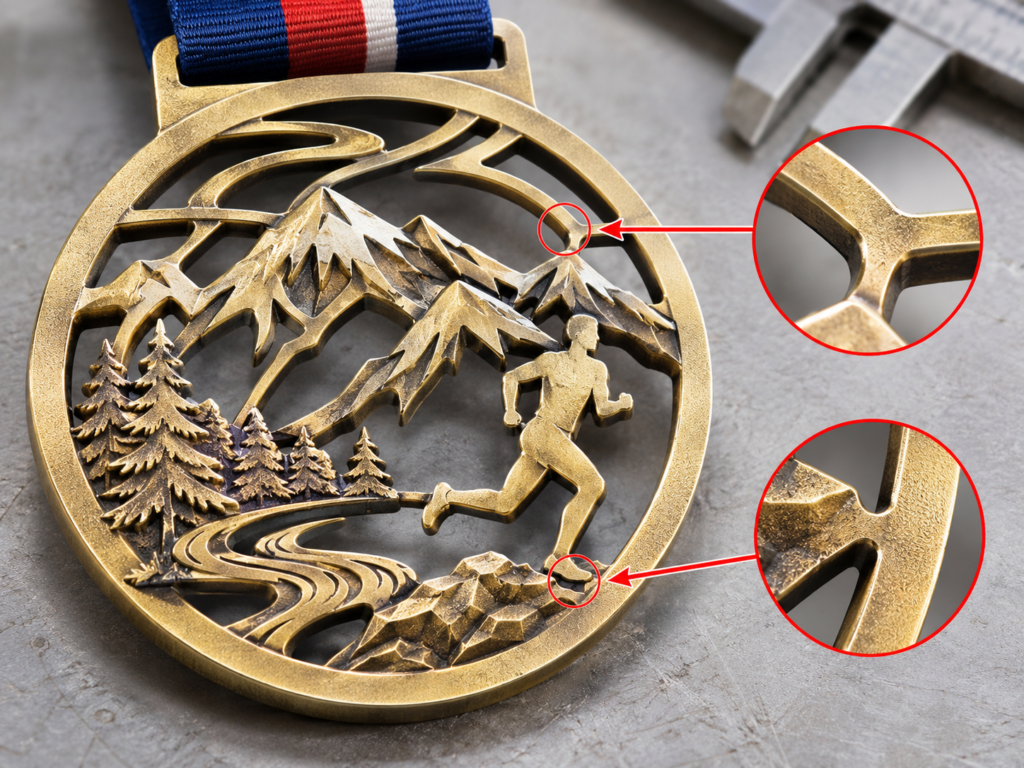
Imagine a medal featuring a mountain landscape, where the open spaces between the peaks are completely cut out, leaving only thin metal ridges connecting the design.
Visually, this could create a striking result.
However, if some of the metal connections are too narrow, we need to evaluate their strength, the feasibility of die casting, and the requirements of any subsequent finishing processes.
When large open areas are supported by only a few thin connections, there may be risks of deformation, breakage, or other quality issues during manufacturing or use.
This doesn’t mean cutout medals cannot be manufactured.
In fact, cutout designs are quite common in custom metal medals.
The important thing is to balance the openings, connecting sections, material thickness, and overall medal dimensions.
Sometimes, slightly widening a connecting section or adjusting part of the artwork is enough to preserve the original appearance while making the design more suitable for production.
That’s why a manufacturer may recommend design changes before moving forward with mold production.
A good design should consider not only how the medal looks, but also whether it can become a reliable physical product.
2. With Complex Medals, the Real Challenge Is Often the Structure
For conventional die-cast zinc alloy medals, many design challenges can be addressed by adjusting dimensions, relief levels, or surface finishes.
But when a design involves multiple components, things can become considerably more complicated.
For example:
- Several individual medals that connect to form one complete image.
- Medals with built-in magnets that allow different pieces to attach to each other.
- Medals with opening, rotating, or other moving mechanisms.
- Designs that require separate metal components to fit together in a particular way.
These features don’t just change the appearance of a medal. They introduce mechanical and structural requirements.
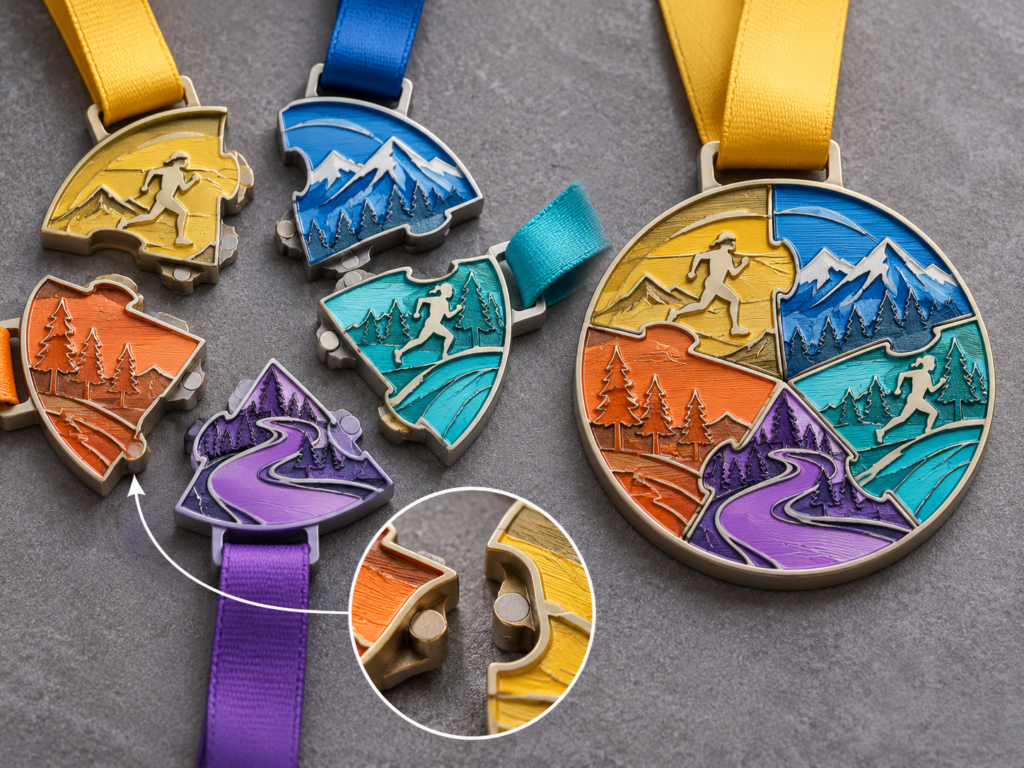
We once discussed a project involving five individual medals designed to form a complete circular image when placed together.
The customer wanted each medal to be worn separately, while also allowing all five pieces to combine into one design.
The original concept included magnetic connections.
At first glance, the idea seemed straightforward: create five differently shaped metal pieces, install magnets along the edges, and let them connect.
But as we examined the concept, we realized there was an important question to answer first:
Were the medals only meant to form a complete image when laid flat on a table, or did the customer want to lift the assembled medals as one connected piece?
These two situations require different structural considerations.
If the medals are only intended for flat display, the main concerns are the connecting edges, magnet positions, and how the assembled design looks.
But if the customer wants to lift all five medals together, we also need to consider magnetic holding force, connection direction, the weight of the metal components, and how the assembly behaves under load.
Manufacturing tolerances are another consideration. Edges that fit perfectly together in a digital image may not be completely seamless when produced as real metal components.
These questions cannot be answered simply by looking at an AI-generated image.
They require an assessment of the product’s dimensions, materials, weight, and intended use. Some solutions may also need physical samples to verify their performance.
Different structural solutions can also lead to significant differences in tooling, manufacturing, and assembly costs.
A feature that seems like a small addition to the design may actually change how the entire product needs to be manufactured.
That’s why, when discussing complex medal structures, we prefer to understand how the customer intends to use the product before recommending a manufacturing solution.
Sometimes, simplifying a mechanism doesn’t mean compromising the creative idea. It means finding a more practical balance between appearance, reliability, and budget.
3. Colors, Lighting, and Fine Details May Look Different in the Finished Medal
Structural design isn’t the only challenge.
Another common issue is the difference between a digital concept image and the appearance of real materials.
AI is particularly good at creating dramatic lighting effects.
It can make metal look exceptionally bright, give relief designs an exaggerated sense of depth, and produce complex textures and color gradients.
But a visual effect in an image doesn’t automatically correspond to a specific manufacturing process.
Consider color application on metal medals.
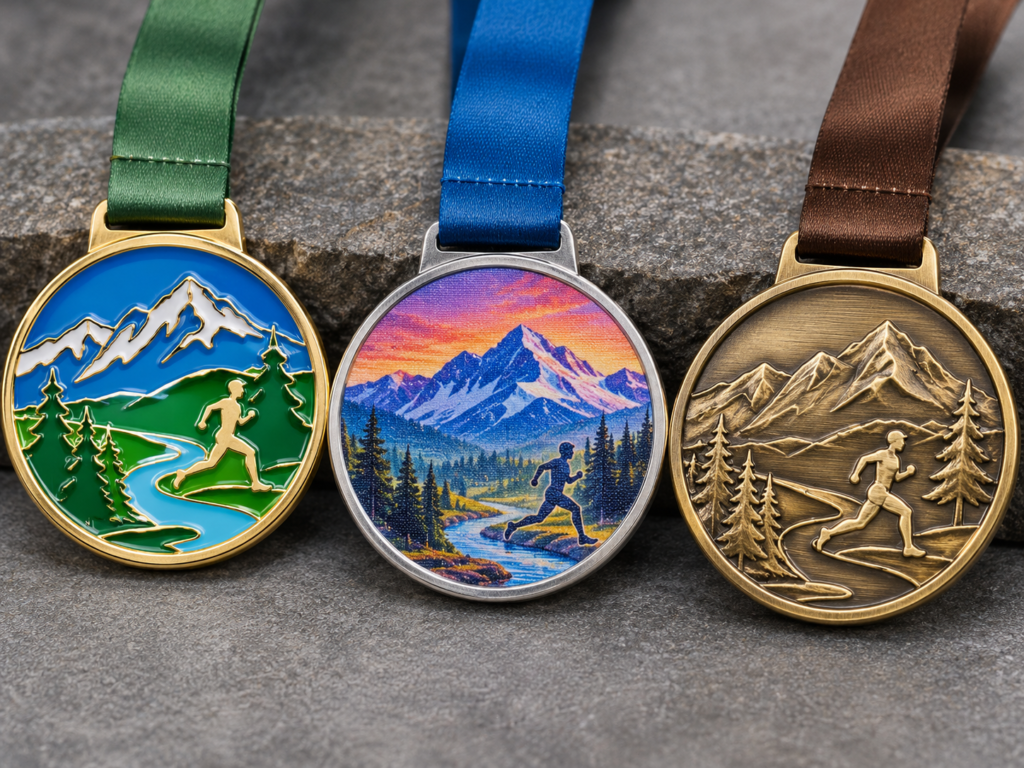
If a design contains clearly separated areas of solid color, we can evaluate whether enamel-style color filling would be suitable, depending on the structure and design requirements.
However, if the artwork includes complex gradients, photographic effects, or extremely fine colored details, UV printing may be a more appropriate option.
Both processes have their advantages and limitations. Neither is automatically better than the other.
The same issue applies to relief effects.
AI-generated medal images often use strong shadows to create the appearance of depth. In actual production, however, relief height, edge transitions, mold design, and reflections from the plated metal surface all influence the final appearance.
Sometimes, what looks like a deep groove in the image is simply an effect created by lighting and shadows.
If that visual effect is interpreted as an actual three-dimensional feature, the finished medal may look different from what the customer expected.
Text can present similar challenges.
A medal design may appear very large on a computer screen, but the actual product might only measure 50 mm, 60 mm, or 70 mm in diameter.
Once the artwork is reduced to its real dimensions, some small lettering, fine lines, and decorative details may lose clarity.
Adjustments to font size, spacing, line thickness, or relief details may therefore be necessary.
When reviewing an AI-generated medal design, it’s worth asking a few practical questions:
Which effects need to be created through physical metal structures? Which can be achieved with surface printing? And which are simply lighting effects in the image?
Understanding these differences helps everyone develop more realistic expectations for the finished product.
4. Do Design Changes Always Increase Manufacturing Costs?
Not necessarily.
This is an area where misunderstandings can easily arise.
Some customers assume that once their artwork is finished, any design changes suggested by the manufacturer will mean additional design expenses.
But that’s not always the case.
In some situations, modifying a design can actually help reduce manufacturing costs.
For example, if a design originally requires several separate metal components, but a similar visual effect can be achieved through a single die-cast piece with different relief levels, it may be possible to reduce the number of components and assembly steps.
Similarly, simplifying details that have little impact on the finished appearance may reduce manufacturing complexity or help avoid unnecessary production risks.
Of course, the opposite can also happen.
If a customer wants to retain moving mechanisms, special connecting systems, or multiple separate materials, additional molds, processing steps, or assembly work may be required.
All of these factors can affect the quotation.
The more useful questions are not simply whether a manufacturer wants to modify the design, but:
Why is the change necessary? What will it affect? And is there a more practical way to achieve the intended result?
In our view, evaluating a design shouldn’t be limited to saying whether something can or cannot be made.
Whenever possible, the manufacturer should also explain the differences between available production options.
Customers deserve to understand what they’re paying for, which design features are worth preserving, and where adjustments can be made without losing the original concept.
5. What Should You Check Before Sending an AI Medal Design for Quotation?
If you’ve already created a medal design using AI, there’s no reason to abandon the idea simply because you’re unsure about manufacturing limitations.
Many creative concepts can be made practical with reasonable adjustments.
However, clarifying a few details before contacting a manufacturer can make the quotation and production process much smoother.
1. What size should the medal be?
Specify the approximate diameter or overall dimensions, along with your preferred thickness.
The same detailed artwork can present very different manufacturing challenges depending on the final size.
2. Which design elements must be preserved?
These might include an event logo, event name, particular illustration, or symbolic detail.
If adjustments are needed, the manufacturer can prioritize the elements that matter most.
3. Does the medal require any special structures or functions?
If the design includes cutouts, magnets, interlocking sections, rotating components, or opening mechanisms, explain how you expect them to work.
A concept image alone may not communicate the intended function clearly.
4. How many medals do you need, and what is your budget?
Order quantity and budget can have a significant influence on the most suitable manufacturing method.
Some complex structures may become more economical in larger production runs because the initial tooling costs are spread across more units.
For small orders, however, the same solution may not be cost-effective.
5. How closely should the finished medal match the AI image?
If the image is mainly a creative reference, there may be more flexibility to adjust the structure and production methods.
If certain colors, fine details, or dimensional effects must be reproduced as closely as possible, those expectations should be discussed before tooling begins.
It’s also important to understand that an AI-generated image usually isn’t a substitute for production-ready vector artwork, dimensioned drawings, or technical design files.
Depending on the complexity of the project, the manufacturer may need to prepare additional artwork, develop technical drawings, or assess the structure before production.
These steps are best completed before mold making begins, rather than discovering problems after the tooling has already been produced.
6. AI Can Help You Start Designing, but Manufacturing Still Requires Judgment
The development of AI design tools has made product design more accessible to many people.
For event organizers, it means they no longer have to begin with a blank page. They can communicate their ideas more directly and potentially reduce the time and cost involved in early design discussions.
We see this as a positive change.
But lowering the barrier to creating a design doesn’t remove the limitations of materials, manufacturing processes, mechanical structures, or production costs.
Sometimes, it simply means that these questions are now being addressed later, during the manufacturing evaluation stage.
A concept image might take only a few minutes to generate. Deciding whether it can be manufactured reliably still requires careful consideration.
If you’re designing a custom medal for your event, it may help to think of your AI-generated image as the starting point of the creative process rather than a finished production plan.
Working with a manufacturing partner who is willing to discuss the details, explain practical limitations, and suggest reasonable adjustments can be more valuable than simply finding a supplier who offers an immediate price.
After all, what you ultimately need isn’t just an impressive image of a medal.
It’s a real medal that can be manufactured, fits your budget, and is ready to be placed in the hands of your event participants.